Dino Dana: Dino Field Guide ー A Comprehensive Overview
Dino Dana’s central device, the Dino Field Guide, empowers young explorers like Dex to visualize and investigate dinosaurs, building upon Dana’s legacy.
The Dino Field Guide is the cornerstone of the Dino Dana universe, a remarkable tool passed down through a family of young paleontologists. Initially wielded by Dana, and now in the capable hands of her younger brother Dex, this isn’t just a book – it’s a portal to the prehistoric world. Dex, a nine-year-old artist and explorer, utilizes the Field Guide to magically observe and study dinosaurs existing within our modern environment.

This extraordinary device allows its user to see beyond the ordinary, revealing the dinosaurs that once roamed the Earth. Inheriting the Field Guide represents a significant moment for Dex, launching him into a grand experiment: challenging conventional understandings of dinosaur appearance and behavior. Like his sister and cousins before him, Dex embarks on thrilling adventures, fueled by curiosity and the power of the Field Guide to unlock the secrets of these magnificent creatures.
The Magic Behind the Field Guide
The Dino Field Guide’s magic isn’t simply about visualization; it’s a complex interaction between technology and a unique connection to the prehistoric world. The Guide doesn’t create dinosaurs, but rather allows the user to see them as they truly are, existing alongside us in a way previously undetectable. This ability stems from a mysterious energy source embedded within the device, responding to the user’s intent and paleontological curiosity.
Dex, like Dana before him, activates this power through focused observation and a deep desire to understand dinosaurs. The Field Guide responds to this passion, overlaying a “Dino Vision” onto reality, revealing the ancient creatures in their natural habitats. This isn’t illusion, but a shift in perception, granting access to a hidden layer of existence. The true source of the magic remains a captivating mystery within the Dino Dana narrative.
Dex and the Legacy of the Field Guide
Dex inherits the Dino Field Guide from his sister, Dana, stepping into a legacy of paleontological exploration and magical discovery. As a nine-year-old artist and budding paleontologist, Dex approaches the Guide with a fresh perspective, eager to prove his own theories about dinosaur appearance and behavior. He isn’t simply continuing Dana’s work, but forging his own path within the established framework of the Field Guide’s power.
This inheritance represents more than just a technological hand-me-down; it’s a passing of the torch, a responsibility to continue unraveling the mysteries of the prehistoric world. Dex’s “grandest dinosaur experiment” focuses on challenging existing perceptions, suggesting a willingness to question established scientific norms, mirroring the spirit of discovery that defined Dana’s adventures. He embodies the next generation of Dino Field Guide users.

Key Dinosaurs Featured in the Series
Dino Dana showcases iconic dinosaurs like Tyrannosaurus Rex, Triceratops, Velociraptor, and Stegosaurus, bringing these prehistoric creatures to life through the Field Guide;
Tyrannosaurus Rex – The King
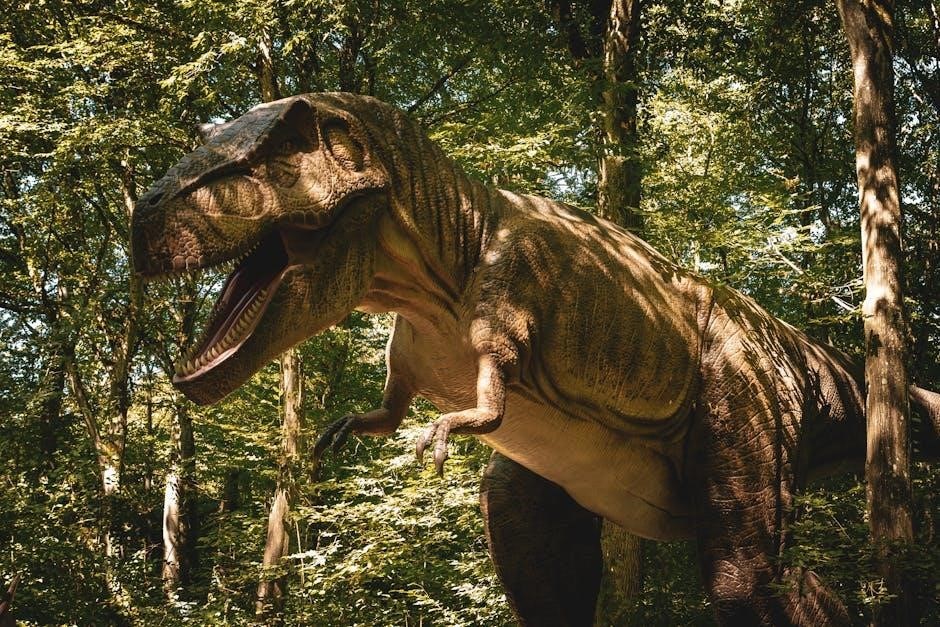
Tyrannosaurus Rex, often hailed as the “King of the Dinosaurs,” receives significant attention within Dino Dana, showcasing its immense power and fascinating characteristics. The Dino Field Guide allows Dex, and previously Dana, to observe this apex predator in detail, moving beyond traditional depictions.
The series explores not only the T. Rex’s formidable hunting abilities but also delves into potential behaviors, like social interactions and even parental care, utilizing the Field Guide’s advanced observational capabilities. Viewers witness the T. Rex in its environment, gaining insights into its biomechanics and how it navigated its prehistoric world.
Dino Dana doesn’t simply present the T. Rex as a monstrous threat; it portrays a complex creature with nuanced behaviors, challenging preconceived notions. The Field Guide’s data reveals details about its potential speed, bite force, and sensory perception, offering a scientifically informed, yet imaginative, portrayal of this iconic dinosaur.
Triceratops – The Horned Giant
Triceratops, the iconic horned dinosaur, is a frequent subject of study through the Dino Field Guide in Dino Dana. Dex utilizes the guide to examine the function of its frill and horns, moving beyond simple defense mechanisms to explore potential display and communication purposes.
The series showcases Triceratops not just as a formidable herbivore, but as a social animal, potentially living in herds for protection and resource sharing. The Dino Field Guide allows for detailed observation of its feeding habits, revealing how it processed tough vegetation with its beak-like mouth and dental batteries.
Dino Dana presents a nuanced view of Triceratops, investigating its growth stages and potential variations within the species. The Field Guide’s data helps to understand its interactions with predators, like the Tyrannosaurus Rex, and how it utilized its unique anatomy for survival in the Cretaceous period.
Velociraptor – The Clever Hunter
Velociraptor, often depicted as a highly intelligent and agile predator, is a key dinosaur investigated with the Dino Field Guide in Dino Dana. Dex employs the guide to analyze its hunting strategies, revealing a creature far more complex than a simple brute force attacker.
The series highlights Velociraptor’s potential for cooperative hunting, suggesting pack behavior to take down larger prey. The Dino Field Guide provides insights into its sickle-shaped claw, examining its use in pinning down victims and delivering precise, disabling strikes. It’s not just about the claw, but the coordinated attack.
Dino Dana explores Velociraptor’s sensory capabilities, including its keen eyesight and possible feathered plumage, contributing to a more accurate and compelling portrayal. The Field Guide’s data helps understand its role within the Cretaceous ecosystem and its interactions with other dinosaurs.
Stegosaurus – The Plated Dinosaur
Stegosaurus, instantly recognizable by its distinctive plates and spiked tail, becomes a fascinating subject of study through Dex’s use of the Dino Field Guide in Dino Dana. The series delves into the ongoing debate surrounding the function of these plates – were they for defense, display, or thermoregulation?
The Dino Field Guide allows Dex to examine the vascularity within the plates, offering clues about potential temperature control. It also investigates the “thagomizer” – the spiked tail – analyzing its effectiveness as a weapon against predators like Allosaurus. The series doesn’t shy away from complex scientific questions.
Dino Dana portrays Stegosaurus as a herbivore adapted to a specific diet, utilizing its beak-like mouth to shear through vegetation. The Field Guide’s data reveals details about its gait and posture, contributing to a more nuanced understanding of this iconic dinosaur’s lifestyle.
How the Field Guide Works
Dino Dana’s Field Guide utilizes “Dino Vision,” activated by the device, to reveal dinosaurs in the real world, offering a detailed database for exploration.
Activating the Dino Vision
Dino Vision, the core functionality of the Dino Field Guide, isn’t simply a matter of pressing a button; it’s a dynamic process linked to observation and curiosity. Like Dana and now Dex, users must actively focus on their surroundings, seeking out potential dinosaur presence. The Field Guide responds to this focused intent, initiating a visual overlay that brings prehistoric creatures into the modern world.
This activation isn’t instantaneous. The Field Guide seems to require a degree of belief and engagement from the user. It’s not enough to just want to see a dinosaur; one must genuinely explore and analyze the environment, looking for clues – fossilized remnants, geological formations, or even behavioral patterns that might suggest a dinosaur’s past presence.
Once activated, Dino Vision transforms the user’s perception, layering digital dinosaur models onto the real-world view. This allows for direct interaction and study, making the learning experience incredibly immersive and engaging. The strength and clarity of the Dino Vision signal can vary, potentially influenced by environmental factors or the user’s level of concentration.
Understanding the Field Guide’s Interface
The Dino Field Guide isn’t just a viewing device; it’s a sophisticated, interactive tool. Its interface, while seemingly intuitive to users like Dex and Dana, possesses layers of functionality. The primary display presents a real-time view of the surroundings, augmented by Dino Vision when activated. Surrounding this central viewport are various informational panels.
These panels display crucial data about observed dinosaurs – species identification, estimated size, potential behaviors, and even dietary habits. Navigation is primarily gesture-based, allowing users to zoom, rotate, and analyze dinosaur models from various angles. A key feature is the ‘Scan’ function, which analyzes environmental data to identify potential dinosaur traces or habitats.
The interface also includes a comprehensive database access point, allowing users to research dinosaurs not currently visible. Furthermore, a recording function enables Dex to document his observations and experiments, contributing to his ongoing paleontological studies. The Field Guide’s interface adapts to the user’s level of expertise, offering simplified views for beginners and advanced options for experienced researchers.
The Field Guide’s Database of Dinosaurs
The Dino Field Guide’s core strength lies within its extensive dinosaur database, a constantly evolving repository of paleontological knowledge. This isn’t a static list; it’s a dynamic system that incorporates new discoveries and refined understandings of prehistoric life. Each dinosaur entry contains detailed anatomical information, including skeletal reconstructions and potential soft tissue appearances;
Beyond physical characteristics, the database delves into behavioral patterns – hunting strategies, social structures, and communication methods. Crucially, the information isn’t presented as definitive fact, but rather as a collection of hypotheses supported by current evidence. Dex can access multiple interpretations for each dinosaur, fostering critical thinking.
The database also features comparative analyses, highlighting evolutionary relationships between different species. Furthermore, it includes paleoenvironmental reconstructions, illustrating the habitats in which these dinosaurs thrived. Regular updates, seemingly sourced from an unknown but advanced scientific network, ensure the Field Guide remains at the forefront of dinosaur research.

Dinosaur Behaviors Revealed by the Field Guide
Dino Field Guide observations unveil intricate dinosaur behaviors, from predatory hunting tactics and herbivore feeding to complex social interactions and communication styles.
Hunting Strategies of Predators
The Dino Field Guide dramatically reveals the diverse and often surprising hunting strategies employed by prehistoric predators. Through Dex’s observations, the series moves beyond simplistic depictions of roaring chases, showcasing nuanced tactics. For instance, Velociraptor isn’t merely a swift runner; the Field Guide demonstrates pack hunting coordination, intelligent ambushes, and potentially even feathered camouflage for stealth.
Tyrannosaurus Rex, while possessing immense power, is shown utilizing a combination of force and opportunistic scavenging, challenging the image of a solely active hunter. The Field Guide highlights how predators adapted to their environments and prey, displaying remarkable intelligence and problem-solving skills. Dex’s ability to ‘see’ these behaviors firsthand, thanks to the Field Guide’s Dino Vision, provides a compelling and educational look into the world of prehistoric predation, moving beyond speculation and into informed observation.
Herbivore Feeding Habits
The Dino Field Guide unveils the surprisingly complex feeding habits of herbivorous dinosaurs, moving beyond the simple image of grazing giants. Dex’s investigations reveal specialized adaptations for consuming various plant matter. Triceratops, for example, isn’t just shown browsing on low-lying vegetation; the Field Guide illustrates how its beak and dental battery were perfectly suited for shearing tough cycads and ferns.
Stegosaurus’s feeding strategy is also explored, demonstrating how it likely used its beak to clip vegetation and relied on gastroliths (stomach stones) to aid digestion. The series emphasizes that herbivores weren’t passive eaters, but actively selected plants based on nutritional value and accessibility. Dex’s Dino Vision allows viewers to witness these behaviors in detail, showcasing the intricate relationship between dinosaurs and their prehistoric ecosystems, and challenging previous assumptions about their diets.
Dinosaur Social Interactions
Dino Dana, through Dex’s Dino Field Guide, moves beyond portraying dinosaurs as solitary creatures, revealing compelling evidence of complex social behaviors. The series showcases how dinosaurs likely lived in herds, families, or even more intricate social structures. Dex observes Triceratops exhibiting protective behaviors towards their young, suggesting strong familial bonds and cooperative defense strategies against predators.
Furthermore, the Field Guide illustrates potential communication methods used during social interactions, like vocalizations and displays. Dex’s research hints at possible dominance hierarchies within herds, influencing access to resources and mating opportunities. The series emphasizes that dinosaur societies weren’t necessarily identical to modern animal groups, but possessed unique adaptations suited to their environment. These observations, facilitated by the Dino Vision, offer a nuanced understanding of dinosaur life beyond simple survival instincts.
Dinosaur Communication Methods
Dino Dana, utilizing Dex’s Dino Field Guide, delves into the fascinating realm of dinosaur communication, moving beyond simple roars. The Field Guide reveals that dinosaurs likely employed a diverse range of signals, including vocalizations, visual displays, and potentially even scent marking. Dex observes Velociraptors utilizing complex calls during hunts, suggesting coordinated strategies and information sharing.
The series showcases how dinosaurs might have used elaborate crests or frills, like those of Triceratops, for visual signaling during mating rituals or territorial disputes. Dex’s research, aided by Dino Vision, explores the possibility of infrasound communication – low-frequency sounds traveling long distances. These methods weren’t merely instinctive; they likely involved learned behaviors and nuanced meanings within dinosaur societies, offering a richer understanding of their complex lives.
The Scientific Accuracy of the Series
Dino Dana prioritizes scientific integrity through paleontological consultation, striving for realistic dinosaur depictions and incorporating the latest discoveries into the Dino Field Guide’s data.
Paleontological Consultation
Dino Dana doesn’t simply present dinosaurs as fantastical creatures; the series demonstrates a strong commitment to scientific accuracy, largely achieved through consistent paleontological consultation. Experts in the field are actively involved in the show’s production, reviewing dinosaur designs, behaviors, and even the information presented within the Dino Field Guide itself.
This collaborative approach ensures that while the show utilizes a magical premise – the ability to see dinosaurs in the real world – the dinosaurs themselves are grounded in current scientific understanding. Consultants provide feedback on everything from feathering patterns and skin textures to skeletal structures and potential movement capabilities. This dedication extends to ensuring the plausibility of dinosaur interactions and ecosystems depicted in each episode.
The goal isn’t necessarily to present a perfectly complete picture of dinosaurs (as our understanding is constantly evolving), but rather to reflect the best available evidence and avoid perpetuating outdated or inaccurate representations. This commitment elevates Dino Dana beyond simple entertainment, transforming it into an educational resource that sparks curiosity and fosters a genuine appreciation for paleontology.
Realistic Dinosaur Depictions
A key element distinguishing Dino Dana is its dedication to portraying dinosaurs with a level of realism rarely seen in children’s programming. This isn’t about simply making the dinosaurs “look scary,” but rather focusing on accurate anatomical details and plausible behaviors, informed by the latest paleontological discoveries. The Dino Field Guide itself reinforces this, presenting information aligned with scientific consensus.
Unlike older depictions often featuring lumbering, reptilian dinosaurs, Dino Dana showcases creatures with dynamic movement, often incorporating evidence suggesting feathered dinosaurs, particularly among theropods. Skin textures, coloration, and even subtle muscle movements are carefully considered to create believable representations. The show avoids portraying dinosaurs as monolithic entities, instead highlighting the diversity within species and individual variations.
This commitment extends to depicting dinosaurs interacting with their environment in ways that are ecologically sound. Hunting strategies, feeding habits, and social behaviors are presented with a degree of nuance, reflecting a deep understanding of paleontological research. The result is a visually compelling and scientifically informed portrayal of prehistoric life.
Incorporating Latest Discoveries
Dino Dana doesn’t exist in a paleontological vacuum; the series actively integrates the most current scientific findings into its depictions of dinosaurs. This commitment to staying up-to-date is crucial, as our understanding of prehistoric life is constantly evolving with new fossil discoveries and analytical techniques. The Dino Field Guide serves as a conduit for presenting these advancements to a young audience.
Recent discoveries regarding dinosaur coloration, feathering, and even social behaviors are reflected in the show’s visuals and narratives. For example, evidence suggesting complex communication methods or parental care is woven into storylines, demonstrating the increasingly nuanced picture paleontologists are painting. The show doesn’t shy away from acknowledging uncertainties, often presenting multiple hypotheses when definitive answers are lacking.
This dynamic approach ensures that Dino Dana remains scientifically relevant and inspires curiosity about the ongoing process of paleontological research. It emphasizes that science isn’t a collection of fixed facts, but a continuous journey of exploration and discovery, fueled by evidence and critical thinking.

Expanding the Dino Field Guide Knowledge
Dino Dana encourages further exploration through museums, fossil sites, and online databases, enriching understanding beyond the Dino Field Guide’s magical realm.
Resources for Further Dinosaur Study
Dino Dana inspires a deeper dive into paleontology beyond the screen! Numerous resources exist to expand your dinosaur knowledge. Museums worldwide, like the American Museum of Natural History in New York or the Royal Tyrrell Museum in Canada, offer incredible fossil exhibits and educational programs.
Fossil sites, where paleontologists unearth dinosaur remains, provide a tangible connection to the past – though visiting requires permits and often involves guided tours. Online databases, such as the Paleobiology Database, offer comprehensive information on dinosaur species, classifications, and discoveries.
AccuWeather.com provides long-term weather forecasts, useful for planning potential fossil hunting trips (though not directly dinosaur-related!). The ICM Kraków website offers detailed meteorological data, demonstrating the scientific rigor applied to understanding natural phenomena, mirroring paleontological research. Exploring these avenues complements the magical learning experience offered by the Dino Field Guide.
Museums and Fossil Sites
Inspired by Dino Dana and the Dino Field Guide, embarking on real-world paleontological adventures is incredibly rewarding! Museums are fantastic starting points. The American Museum of Natural History in New York boasts extensive dinosaur halls, while the Royal Tyrrell Museum in Drumheller, Alberta, Canada, is renowned for its badlands fossil discoveries. London’s Natural History Museum also offers world-class exhibits.
For a more immersive experience, consider visiting fossil sites. Dinosaur Provincial Park in Alberta, and the Hell Creek Formation in Montana, are famous locations, though access often requires guided tours or permits. Remember responsible fossil collecting is crucial – leaving discoveries for professional paleontologists ensures proper study and preservation.
Even checking local weather forecasts, like those from ICM Kraków, can be helpful when planning outdoor explorations! These sites connect the wonder of Dino Dana to tangible evidence of prehistoric life.
Online Dinosaur Databases
Extending the learning sparked by Dino Dana and the Dino Field Guide, numerous online resources offer deeper dives into the world of dinosaurs. The Paleobiology Database (paleobiodb.org) is a comprehensive, peer-reviewed repository of fossil data, perfect for budding paleontologists. Dinosaur Central (dinosaurcentral.com) provides accessible information, images, and facts about various species.
For up-to-date research and discoveries, explore websites affiliated with leading museums like the Smithsonian National Museum of Natural History. Websites offering weather information, like those for Kraków (IMGW), demonstrate the importance of environmental factors in paleontological studies – understanding past climates helps reconstruct dinosaur habitats.
These digital tools complement the magical realism of the show, allowing young explorers to verify facts, discover new species, and continue their paleontological journey beyond the screen, mirroring Dex’s dedication!

The Future of Dino Field Guide Exploration
Dex’s ongoing research, fueled by the Dino Field Guide, promises exciting new dinosaur discoveries and a continued evolution of paleontological understanding.
Potential New Dinosaur Discoveries
Dex, inheriting the Dino Field Guide, is poised to potentially revolutionize our understanding of dinosaurs, challenging existing perceptions of their appearance and behavior. The series hints at the possibility that current depictions may be incomplete, opening doors for groundbreaking revelations.

His “grandest dinosaur experiment yet” focuses on proving that established knowledge regarding dinosaur appearances might be flawed, suggesting a wealth of undiscovered details. This implies the Field Guide could reveal previously unknown species or variations within existing ones.
Furthermore, the magical nature of the Field Guide allows for observation of behaviors and characteristics not typically preserved in the fossil record. This unique perspective could lead to the identification of subtle anatomical features or social dynamics, ultimately expanding the dinosaur family tree and reshaping paleontological narratives. The future holds immense potential for unveiling the true complexity of these prehistoric creatures.
Dex’s Ongoing Research
Following in his sister Dana’s footsteps, Dex diligently utilizes the Dino Field Guide, embarking on continuous paleontological investigations. As a nine-year-old artist, explorer, and paleontologist-in-training, his research isn’t confined to traditional methods; it’s fueled by the Field Guide’s magical capabilities.
Dex’s primary focus centers on validating his hypothesis that current understandings of dinosaur appearances are potentially inaccurate. This involves meticulous observation of dinosaurs brought to life through the Field Guide, documenting subtle details often missed in fossil analysis.
His artistic skills play a crucial role, allowing him to accurately record his findings. This ongoing research promises to contribute significantly to the series’ overarching narrative, potentially uncovering new insights into dinosaur morphology and challenging established scientific consensus. Dex’s dedication ensures the Field Guide’s legacy of discovery continues.
The Evolution of the Field Guide Itself
The Dino Field Guide isn’t a static artifact; it demonstrates a subtle yet significant evolution across generations. Initially wielded by Dana, the Field Guide passed to Dex, suggesting an inherent ability to recognize and empower young, inquisitive minds. This transfer implies the Field Guide possesses a degree of sentience or a mechanism for selecting its user.
While the core functionality – activating Dino Vision and accessing a comprehensive dinosaur database – remains consistent, subtle interface improvements or expanded data entries could emerge with each user. Dex’s unique perspective as an artist might influence how information is presented within the Field Guide.
Future iterations could potentially incorporate new discoveries, adapting to the ever-changing landscape of paleontological research. The Field Guide’s evolution mirrors the ongoing quest for dinosaur knowledge, ensuring its continued relevance and power.